
 English
Introduction: Independent Analysis of Detroit's 2020 Absentee Ballots
This ballot analysis presents an independent review of absentee ballot images from the City of Detroit (Wayne County) in the November 2020 general election. The images were produced through post-election re-scanning of physical absentee ballots processed at Detroit's 134 Absentee Voting Counting Boards (AVCBs) and 503 Precincts (PCTs). Original digital captures from election-day tabulators were not retained, so these re-scanned images were created later to fulfill public records requests.
Due to the COVID-19 pandemic, Michigan saw a dramatic increase in absentee voting. In Detroit, absentee ballots made up the overwhelming majority of votes cast, reflecting expanded mail-in options and public health concerns that reduced in-person Election Day turnout.
The dataset examined here includes thousands of these re-scanned absentee ballot images, primarily hand-marked paper ballots returned by mail or drop box. A custom optical mark recognition (OMR) algorithm was developed to process these images, achieving successful reads on over 99% of cases despite challenges from post-election scanning - such as skewed alignment, folded corners, missing edges, or stray marks.
To ensure transparency and authenticity, all images are presented in their original, unaltered form. No digital corrections (e.g., rotation, cropping, or enhancement) were applied, even where they might have improved readability.
Key findings explored on this site include:
- Scanning quality issues and their limited impact on automated processing.
- An unusual ballot design feature leading to thousands of "ghost write-ins" - filled bubbles with no accompanying candidate name, far exceeding typical write-in rates.
- Comparisons to other jurisdictions and deeper dives into specific races.
The goal is to provide a detailed, data-driven examination of ballot processing and design in one of America's largest cities during a historic election, promoting greater understanding of election mechanics and opportunities for improvement.
Presidential Contest Totals from Independent Analysis
In the November 2020 general election, the City of Detroit's official certified results for the presidential race were approximately:
- Total Votes: 257,619 votes
- Joe Biden: 240,936 votes (93.5% of the total popular vote)
- Donald Trump: 12,889 votes (5.0% of the total popular vote)
For the precise official totals, download the City of Detroit November 3, 2020 General Election Official Results or the Wayne County Election Summary Report.
My independent analysis processed 254,117 re-scanned absentee ballot images from Detroit's Absentee Voting Counting Boards (AVCBs). Note that this represents the vast majority - but not all - of Detroit's absentee ballots, as approximately 3,502 images were not received. Additionally, a small number were unreadable due to scanning issues.
The presidential vote totals from these processed images closely align with official results:
- Total Images: 254,117 votes (3,502 not received)
- Joe Biden: 236,813 votes (93.2% of the total popular vote)
- Donald Trump: 12,753 votes (5.0% of the total popular vote)
Data Source and Ballot Types
The ballot images analyzed on this site come primarily from an open records request, created by Investigative Journalist Yehuda Miller. Almost all of the ballots were hand marked for both absentee and at the precinct during election day. A tiny fraction (~113) were printed by ballot-marking devices (BMDs).
The following links show the total number of ballots received by both the AVCB and Precincts.
- Election Day Ballot Scanning
- Absentee Voting Counting Board (AVCB)
- AVCB Ballots Received
- PCT Ballots Received
Challenges with Ballot Scanning
This analysis is based on digital images of absentee ballots from Detroit (Wayne County) in the November 2020 general election. Because scanning occurred after the election, there was no chance to re-scan or manually review any ballots that the scanners rejected as unreadable. Common issues included ballots that were skewed during scanning, missing corners (likely from handling or wear), or extraneous marks (such as stray ink or smudges) that confused the optical scanners.
In theory, digital image editing could correct many of these problems to improve readability for analysis. However, to maintain full transparency and preserve the authenticity of the records, I chose to present the original, unaltered images throughout this site.
"Ghost Write-Ins": Blank Write-In Votes on Detroit Ballots
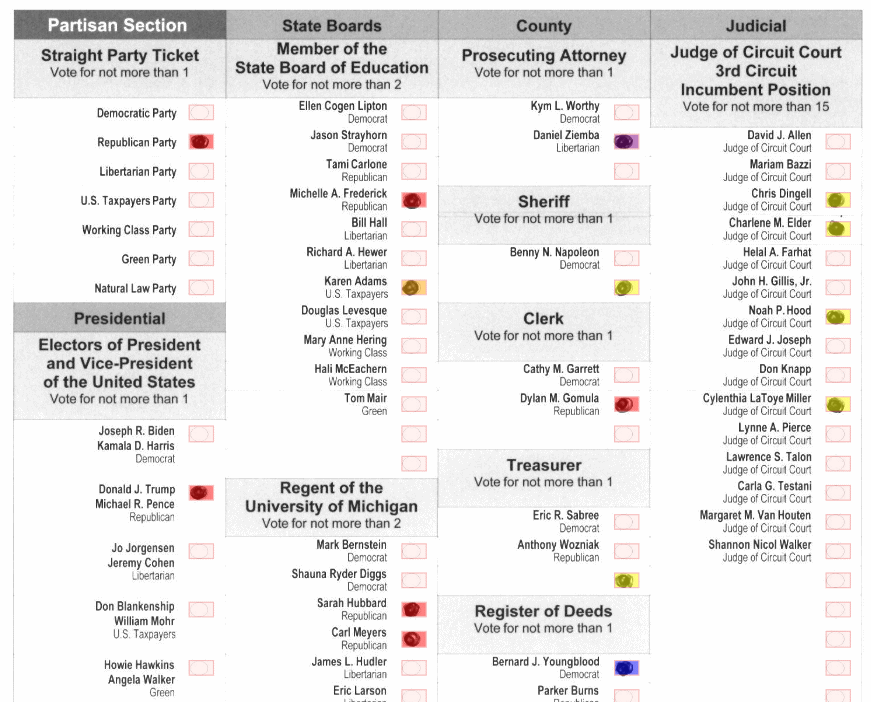
One unusual feature of Detroit's 2020 ballot design was the placement of write-in bubbles directly below the printed candidates for each contest-without any accompanying text, label, or instruction like "Write-in" or "Other."
This was particularly noticeable in judicial races with many seats open. For example, one contest for Judge of the 3rd Circuit Court had 15 candidates running for 15 positions, resulting in 15 unlabeled write-in bubbles appearing on the ballot.
While one might expect voters to ignore unmarked bubbles, a surprising number filled them in-without writing any name.
These "ghost write-ins" (filled bubbles with no accompanying name) totaled 11,336 across relevant contests, representing about 4.47% of all ballots cast in Detroit. This rate is notably higher than typical write-in activity in most elections, where valid write-ins (with an actual name) usually make up a tiny fraction of votes.
This pattern raises legitimate questions about ballot clarity, voter understanding, and how design choices may influence voting behavior-especially for voters unfamiliar with the process or using absentee ballots.
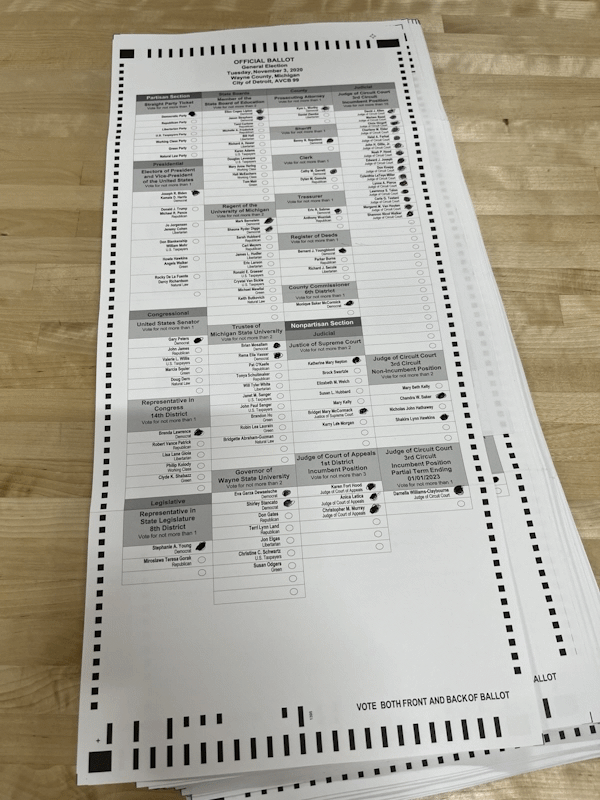
Example of a Detroit 2020 ballot section with unlabeled write-in bubbles below candidate options.