
 English
Wayne County, Michigan
2020 Presidential Election
Background and Overview
This dataset contains ballot images from the 134 Absentee Voting Counting Boards (AVCBs) in the City of Detroit that processed ballots during the 2020 Presidential Election.
Due to the COVID-19 pandemic, Wayne County and the City of Detroit significantly expanded it's voting options. As a result, a substantial portion of the county’s total vote came through these AVCB locations rather than traditional Election Day precincts.
Following the election, the original digital images captured by tabulators were not preserved. Through a Freedom of Information Act (FOIA) request, election staff later re-scanned the physical paper ballots to produce these images for public review.
The vast majority of these ballots were traditional hand-marked paper ballots. My custom optical mark recognition (OMR) algorithm successfully processed the overwhelming majority of them, with only a small fraction requiring manual review due to scanning issues.
Unreadable Hand-Marked Ballots
Approximately 224 hand-marked ballot images could not be reliably processed automatically. The primary causes were severe rotation (many entire batches consistently skewed by -20 degrees or more), large black borders from scanning, upside-down orientation, or folded/missing corners.
Rather than digitally altering the original images (e.g., rotating, deskewing, or cropping), I preserved them exactly as received to maintain authenticity and allow independent verification.
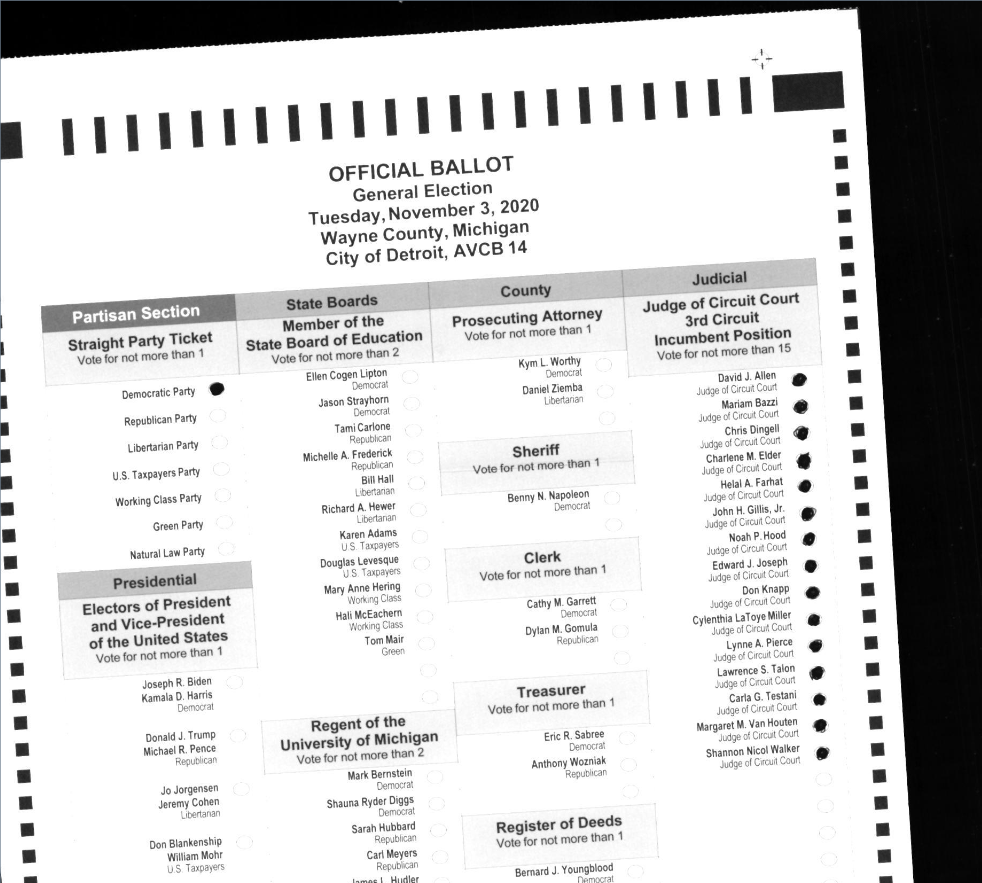
Severe batch rotation/skew
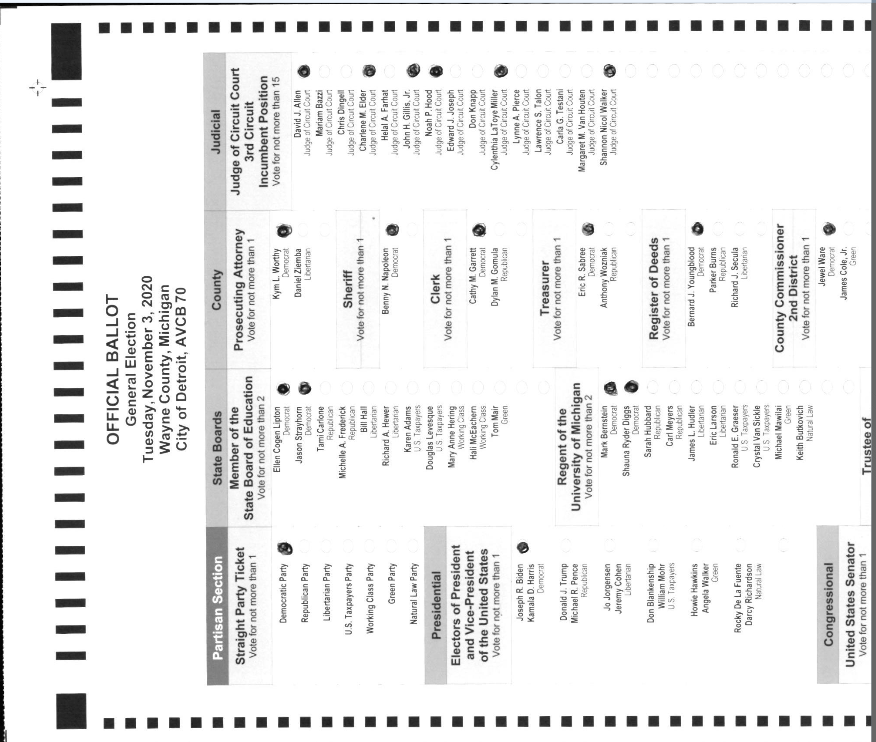
Rotated 90 degrees
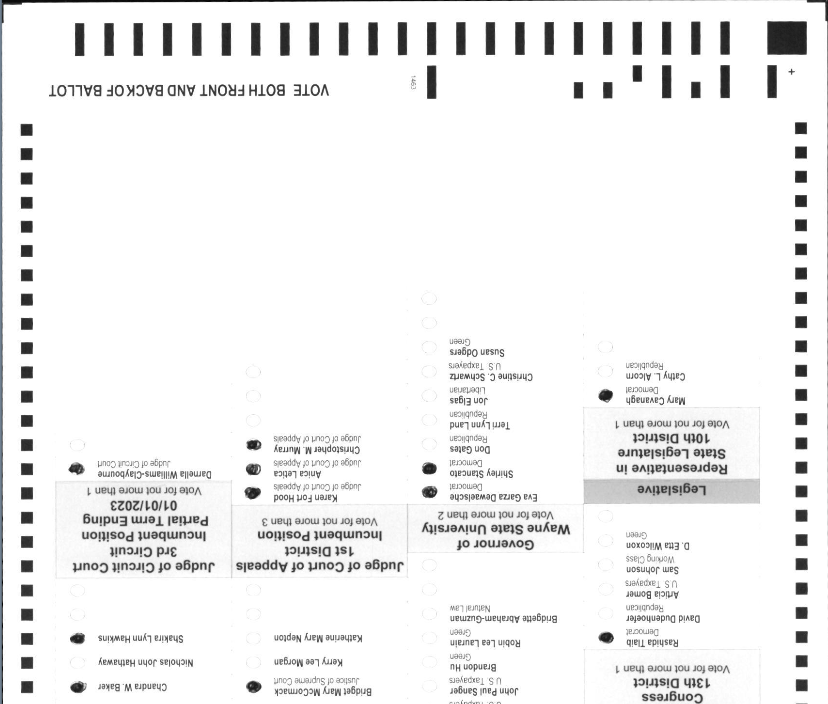
Completely upside down
Mini-Ballots (Reduced-Size Scans)
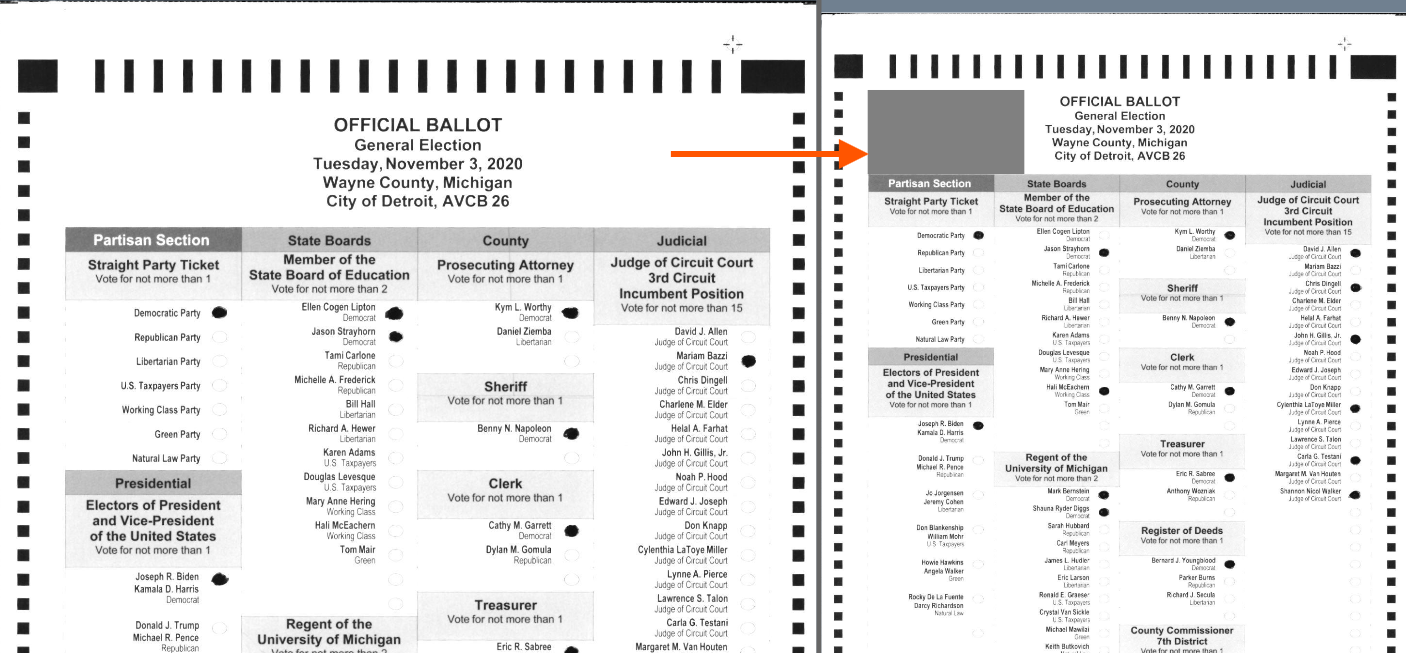
Seven ballots in the dataset appeared as significantly smaller “mini-ballots” scanned at only 125 dpi (compared to the standard 200 dpi). These images also frequently contained large random gray rectangles with no discernible pattern, rendering them unprocessable by the algorithm.
Non-Ballot Materials Included in Scans
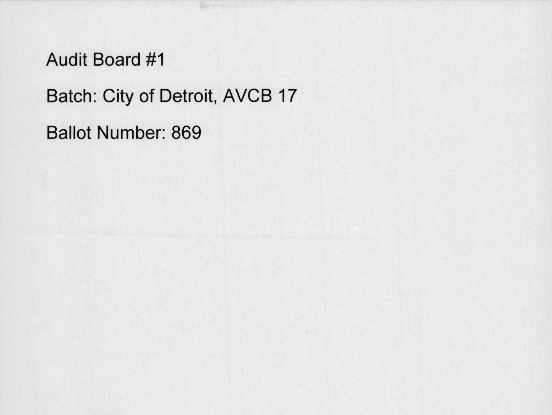
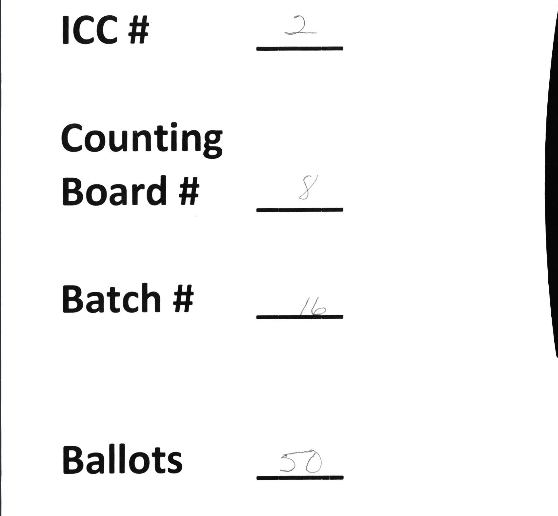
Approximately 14 scanned items were not valid ballots. These included batch cover sheets, audit board placeholders, counting board summary forms, and other administrative papers mistakenly included in ballot bundles. Many were single-sided, which caused minor issues during PDF-to-image conversion.
Common examples:
- Audit board placeholder sheets – typically used to account for duplicated or spoiled ballots.
- Counting board tracking sheets – used to record batch ballot counts and tabulator information.
Ballot-Marking Device (BMD) Ballots
Only one ballot in this entire AVCB dataset was printed by a ballot-marking device (BMD), containing machine-printed text and a QR code. Given its isolated nature, it has been set aside for potential future detailed analysis.
Conclusion
Re-scanning a large volume of early in-person ballots after the election using non-specialized equipment was a considerable effort. Election staff operated under difficult post-election conditions and delivered images of generally high quality.
Minor issues—such as non-ballot materials, inconsistent scan orientation across batches, and a small number of reduced-resolution images—were present but did not prevent thorough independent review of the vast majority of ballots.
When comparing independently derived vote totals from these images to official certified results, small differences in raw counts are expected, particularly since early in-person voting represented a significant but partial share of Wayne County’s total 2020 vote.
A more exhaustive analysis could achieve near-complete automated processing by applying targeted, non-destructive corrections to the problematic subset—such as digital rotation for upside-down or skewed batches and cropping of excessive borders—while retaining the unaltered originals for verification.
Overall, the availability and successful independent processing of this large collection of early in-person ballot images adds meaningful transparency to the 2020 Presidential Election results in Wayne County, Michigan.